<?xml version="1.0" encoding="utf-8"?><feed xmlns="http://www.w3.org/2005/Atom" ><generator uri="https://jekyllrb.com/" version="3.10.0">Jekyll</generator><link href="https://alexanderjbaker.github.io/feed.xml" rel="self" type="application/atom+xml" /><link href="https://alexanderjbaker.github.io/" rel="alternate" type="text/html" /><updated>2026-06-22T12:38:49+00:00</updated><id>https://alexanderjbaker.github.io/feed.xml</id><title type="html">Alexander J. Baker</title><subtitle>Senior Research Scientist, National Centre for Atmospheric Science and Department of Meteorology, University of Reading</subtitle><author><name>Alexander J. Baker, Ph.D.</name><email>alexander.baker@reading.ac.uk</email></author><entry><title type="html">Hurricane Melissa and the rapid intensification of tropical cyclones</title><link href="https://alexanderjbaker.github.io/posts/2025/10/hurricane-melissa-and-the-rapid-intensification-of-tropical-cyclones/" rel="alternate" type="text/html" title="Hurricane Melissa and the rapid intensification of tropical cyclones" /><published>2025-10-31T00:00:00+00:00</published><updated>2025-10-31T00:00:00+00:00</updated><id>https://alexanderjbaker.github.io/posts/2025/10/hurricane-melissa-and-the-rapid-intensification-of-tropical-cyclones</id><content type="html" xml:base="https://alexanderjbaker.github.io/posts/2025/10/hurricane-melissa-and-the-rapid-intensification-of-tropical-cyclones/"><![CDATA[<p>Hurricane Melissa is tearing through the Caribbean, bringing record-breaking wind and torrential rain to Jamaica—the island’s first ever category-5 landfall. What makes Melissa so alarming isn’t just its size and strength, but the speed with which it became so powerful. In a single day, it exploded from a moderate storm into a major hurricane with 170mph winds.</p>

<p>Scientists call this <a href="https://theconversation.com/topics/rapid-intensification-109497">‘rapid intensification’</a>. As the planet warms, this violent strengthening is becoming more common. These storms are especially dangerous as they often catch people off guard. That’s because forecasting rapid intensification, although improving, <a href="https://journals.ametsoc.org/view/journals/wefo/35/6/WAF-D-19-0253.1.xml">remains a huge challenge</a>.</p>

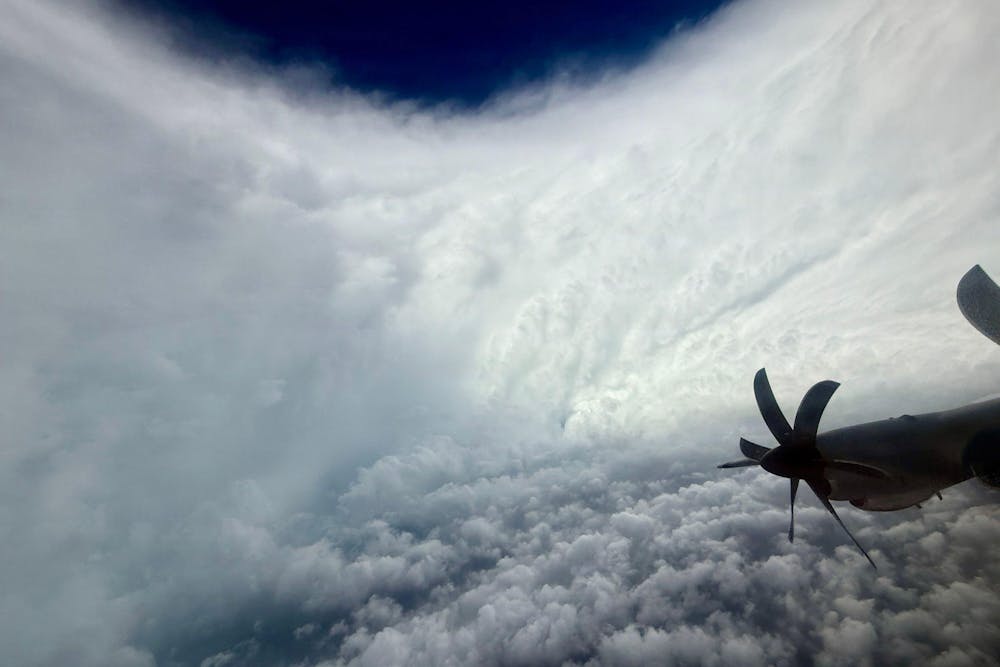
<p>Better forecasting will depend on more detailed monitoring of a hurricane’s inner core—especially close to the eyewall (see Figure), where the strongest winds occur—and on higher-resolution computer models that can <a href="https://agupubs.onlinelibrary.wiley.com/doi/10.1029/2024GL109841">better capture a storm’s complex structure</a>. New machine learning (AI) techniques <a href="https://journals.ametsoc.org/view/journals/wefo/40/10/WAF-D-24-0228.1.xml">may help</a> but are largely untested.</p>

<p><img src="/images/blog/hurricane_melissa.jpg" alt="Inside the eye of Hurricane Melissa." />
<strong><em>Figure</em></strong> | <em>Inside the eye of Hurricane Melissa. Photo taken by U.S. Air Force ‘Hurricane Hunters’. Photograph by Lt. Col. Mark Withee/USAF/UPI/Alamy.</em></p>

<p>As things stand, rapidly intensifying storms mean that communities are often provided little warning to evacuate, and government agencies may have little time to make preparations, such as opening evacuation shelters or preparing critical infrastructure.</p>

<p>That’s what happened with <a href="https://theconversation.com/extreme-weather-is-outpacing-even-the-worst-case-scenarios-of-our-forecasting-models-216562">Hurricane Otis</a> in Mexico in 2023 and Typhoon Rai in the Philippines in 2021. Both rapidly intensified shortly before landfall, and hundreds of people died because they were unable to reach safety.</p>

<p>Fortunately, the chance of Melissa reaching category 5 was forecast sometime before it made landfall, helped by the storm moving very slowly towards Jamaica.</p>

<h3 id="perfect-storms">Perfect storms</h3>

<p>A particular set of conditions are required to fuel rapid intensification: high humidity in the atmosphere, low wind shear (the change in wind speed with height), and warm sea-surface temperatures. Recent <a href="https://www.nature.com/articles/s41467-022-34321-6">research</a> suggests that, since the early 1980s, warmer seas and a more moist atmosphere means these conditions are becoming more common. These trends can’t be explained by natural variability. It seems human-caused climate change is significantly increasing the probability of rapid intensification.</p>

<p>In the case of Melissa, the fingerprints of climate change are visible on many of the factors that made it such a devastating storm. Sea-surface temperatures in the region are currently more than a degree above normal—conditions that may be <a href="https://www.climatecentral.org/tropical-cyclones/melissa-2025">500 to 800 times more likely due to climate change</a>. Warmer seas provide extra energy for a storm’s intensification. Rising sea levels also mean storm surges and coastal flooding are more severe.</p>

<p>Scientists are confident that rainfall is increasing as a result of climate change, because a warmer atmosphere holds more moisture, <a href="https://www.nature.com/articles/s41467-021-25685-2">a trend evident in the North Atlantic</a>. Melissa is travelling slowly, which leads to higher rainfall totals over land. Forecasts predicted mountainous regions of Jamaica <a href="https://www.bbc.com/news/articles/cp3d71q32w5o">could receive up to a metre of rainfall</a>, raising the risk of severe flooding and landslides.</p>

<p><a href="https://www.nature.com/articles/s41586-018-0158-3">Some studies</a> even suggest climate change is slowing down the speed of cyclones themselves (the rate at which the whole storm moves). This would mean they linger over land and dump more rain. <a href="https://climatelabbook.substack.com/p/a-damaging-hurricane-in-a-warmer">Simulations</a> by a colleague of ours at the University of Reading confirmed that past hurricanes striking Jamaica would produce more rainfall in today’s warmer climate.</p>

<p>The growing tendency for storms to rapidly intensify is helping more of them to reach the strongest categories, and that can be deadly when this surge in strength is not well forecasted. As the planet warms, this risk will only grow. That makes it crucial for scientists to improve hurricane monitoring and forecast models, as well as for emergency responders to prepare for the scenario of an intense hurricane arriving with little time to prepare.</p>

<p>Hurricane Melissa has brought the risks into sharp focus: storms are intensifying faster, hitting harder and giving people less time to escape. ♦</p>

<h3 id="authors-note">Author’s note</h3>

<p>This article was written with <a href="https://research.reading.ac.uk/meteorology/people/liz-stephens/">Prof. Liz Stephens</a> (University of Reading and Red Cross Red Crescent Climate Centre) and originally published in <em><a href="https://theconversation.com/hurricane-melissa-is-a-warning-why-violent-storms-are-increasingly-catching-the-world-off-guard-268604">The Conversation</a></em> with additional graphics and under the title ‘Hurricane Melissa is a warning—why violent storms are increasingly catching the world off guard’. At the time of writing, this article had been shared<sup><a href="https://www.linkedin.com/posts/jagan-chapagain_hurricane-melissa-why-are-storms-getting-activity-7390331099685593088-HvVd">1</a>,<a href="https://x.com/jagan_chapagain/status/1984563765602365670">2</a></sup> by <a href="https://www.ifrc.org/who-we-are/people-and-structures/secretary-general">Jagan Chapagain</a>, Secretary General and CEO of the International Federation of Red Cross and Red Crescent Societies, and republished under the CC BY-ND 4.0 licence by:</p>

<p><a href="https://www.preventionweb.net/news/hurricane-melissa-warning-why-violent-storms-are-increasingly-catching-world-guard">UN Office for Disaster Risk Reduction (PreventionWeb)</a><br />
<a href="https://www.climatecentre.org/16203/hurricane-melissa-is-a-warning-why-storms-are-getting-more-violent/">Red Cross Red Crescent Climate Centre</a><br />
<a href="https://research.reading.ac.uk/research-blog/2025/10/30/hurricane-melissa-is-a-warning-why-violent-storms-are-increasingly-catching-the-world-off-guard/">Connecting Research (University of Reading)</a><br />
<a href="https://blogs.reading.ac.uk/weather-and-climate-at-reading/2025/hurricane-melissa-is-a-warning-why-violent-storms-are-increasingly-catching-the-world-off-guard/">Weather and Climate @ Reading</a><br />
<a href="https://ca.news.yahoo.com/hurricane-melissa-warning-why-violent-170520363.html?guccounter=1">Yahoo! News</a><br />
<a href="https://iol.co.za/ios/opinion/2025-10-30-melissa-is-a-warning-violent-storms-are-increasing/#google_vignette">IOL</a><br />
<a href="https://www.sciencealert.com/how-record-breaking-hurricane-melissa-became-a-monster-overnight">ScienceAlert</a><br />
<a href="https://www.europe-solidaire.org/spip.php?article76817">Europe Solidaire Sans Frontières</a><br />
<a href="https://www.ptinews.com/story/international/hurricane-melissa-is-warning-why-violent-storms-are-increasingly-catching-world-off-guard/3048988">Press Trust of India</a><br />
<a href="https://www.bizzbuzz.news/trendz/when-storms-are-warning-the-climate-behind-melissas-fury-1376097#google_vignette">BizzBuzz</a><br />
<a href="https://www.tolerance.ca/ArticleExt.aspx?ID=590737&amp;L=en">Tolerance</a></p>]]></content><author><name>Alexander J. Baker, Ph.D.</name><email>alexander.baker@reading.ac.uk</email></author><category term="tropical cyclones" /><summary type="html"><![CDATA[Hurricane Melissa is tearing through the Caribbean, bringing record-breaking wind and torrential rain to Jamaica—the island’s first ever category-5 landfall. What makes Melissa so alarming isn’t just its size and strength, but the speed with which it became so powerful. In a single day, it exploded from a moderate storm into a major hurricane with 170mph winds.]]></summary></entry><entry><title type="html">Tropical cyclones in state-of-the-art climate models</title><link href="https://alexanderjbaker.github.io/posts/2024/08/tropical-cyclones-in-state-of-the-art-climate-models/" rel="alternate" type="text/html" title="Tropical cyclones in state-of-the-art climate models" /><published>2024-08-28T00:00:00+00:00</published><updated>2024-08-28T00:00:00+00:00</updated><id>https://alexanderjbaker.github.io/posts/2024/08/tropical-cyclones-in-state-of-the-art-climate-models</id><content type="html" xml:base="https://alexanderjbaker.github.io/posts/2024/08/tropical-cyclones-in-state-of-the-art-climate-models/"><![CDATA[<p>Tropical cyclones, including hurricanes and typhoons, rank among the most costly natural hazards. Recent research has revealed an increasing trend in the destructiveness of tropical cyclones over the last few decades, and highlighted the fact that socioeconomically underprivileged populations are disproportionately exposed to their impacts. Simulating realistic tropical cyclones is therefore a vital ambition in weather and climate modelling.</p>

<blockquote>
  <p>Tropical cyclones are born from ‘seeds’—tropical waves or rotating clusters of individual thunderstorms—in a process lasting from hours to weeks. This occurs at low latitudes over warm tropical oceans and, usually, at least a thousand kilometres from the equator, where planetary rotation is sufficient to aggregate convective activity into a coherent vortex. Once formed, tropical cyclones mature, increasing in intensity. Typically, they propagate westward and poleward before reaching the midlatitudes, where they weaken over a cooler ocean surface or transform into frontal weather systems.</p>
</blockquote>

<p>The physical processes that govern a tropical cyclone’s lifecycle are relatively well understood, but many of these processes occur at scales below those resolved by global climate models. Simulated tropical cyclones intensify too slowly and fail to reach the highest category-four and -five strengths observed. Increasing the resolution of models may improve realism. In the ongoing <a href="https://nextgems-h2020.eu/">nextGEMS project</a>, two climate models are being developed to run at resolutions of around five kilometres—an order-of-magnitude improvement over typical models. Such simulations require significant computational resources, so for now model runs are around five years. Nonetheless, the data being produced offer up opportunities to explore state-of-the-art model capabilities.</p>

<p>In <a href="https://agupubs.onlinelibrary.wiley.com/doi/10.1029/2024GL109841">a new study</a> published in <em>Geophysical Research Letters</em>, my colleagues and I used an algorithm to identify tropical cyclones in nextGEMS data, and analysed a range of simulated tropical cyclone characteristics. Here, I’ll describe our findings for two key ones: the frequency of tropical cyclones and how quickly they intensify—both highly relevant to cyclone predictability and societal impacts.</p>

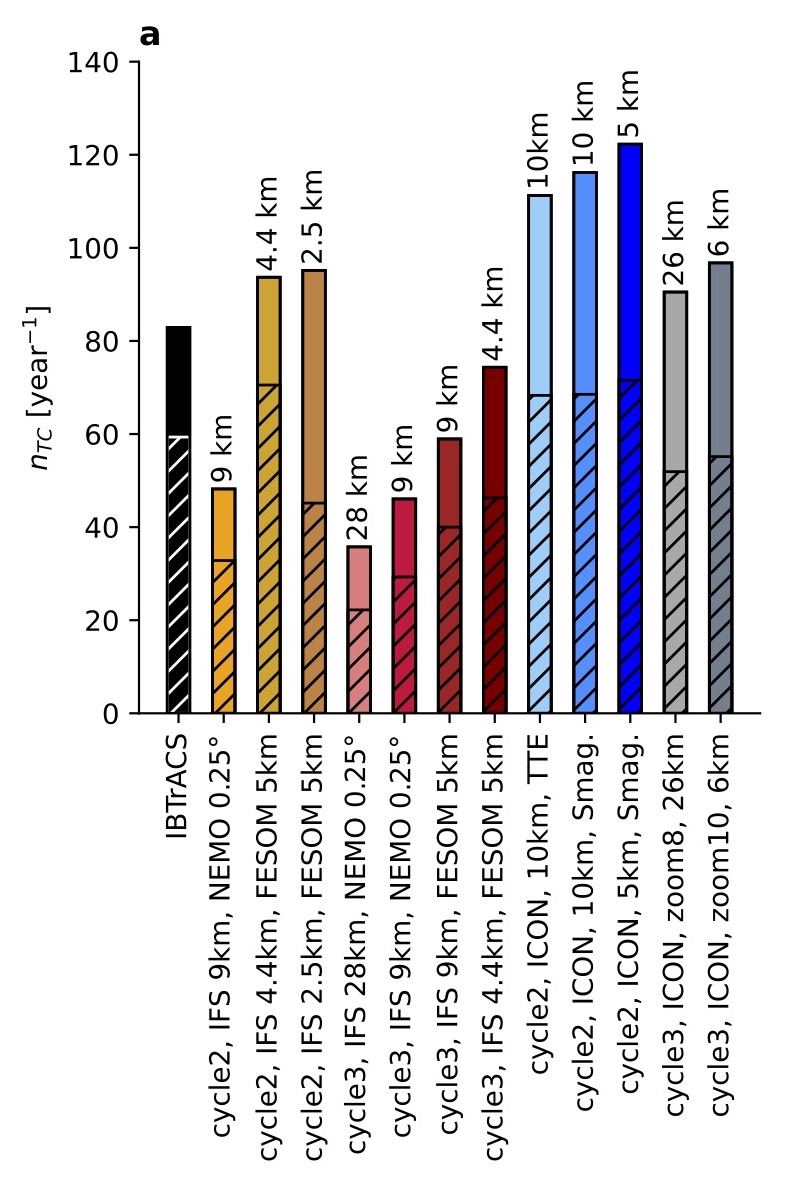
<p>Simulated tropical cyclone frequency is sensitive to both model resolution and model physics. We compared the observed annual-mean number of tropical cyclones with that simulated by nextGEMS models (Figure 1). In one model, the <a href="https://www.ecmwf.int/en/forecasts/documentation-and-support/changes-ecmwf-model">Integrated Forecasting System (IFS)</a>, the annual number is closer to observations at higher atmospheric resolutions. Tropical cyclone frequency also changes with ocean model and resolution. Higher counts are seen in an IFS simulation at 9 km resolution in the atmosphere coupled to a high-resolution ocean model (the <a href="https://fesom.de/">Finite-Element Sea Ice-Ocean Model (FESOM)</a> at a resolution of 5 km) than that same atmosphere coupled to lower-resolution ocean (the <a href="https://www.nemo-ocean.eu/">Nucleus for European Modelling of the Ocean (NEMO)</a> at a resolution of 0.25 º).</p>

<p>A different climate model, the <a href="https://www.icon-model.org/">Icosahedral Non-hydrostatic Weather and Climate (ICON)</a> model, shows sensitivity to model physics, rather than to changes in resolution (Figure 1). Simulated cyclone frequency was initially too high (see “cycle 2”), but is closer to observations following model improvements (see “cycle 3”). Overall, both IFS and ICON perform better globally than for the Northern Hemisphere, suggesting that further model improvements are still needed to capture some of the regional details of tropical cyclone activity.</p>

<p><img src="/images/blog/2024-08-28_fig1.jpg" alt="Figure 1" />
<strong><em>Figure 1</em></strong> | <em>Annual-mean tropical cyclone frequency (“nTC”) in observations (“IBTrACS”) over the period 1980–2022 (black) and nextGEMS simulations performed in model-development cycles 2 and 3. Bars represent global frequency and hatched areas represent the Northern Hemisphere. The atmospheric resolution is indicated above each bar.</em></p>
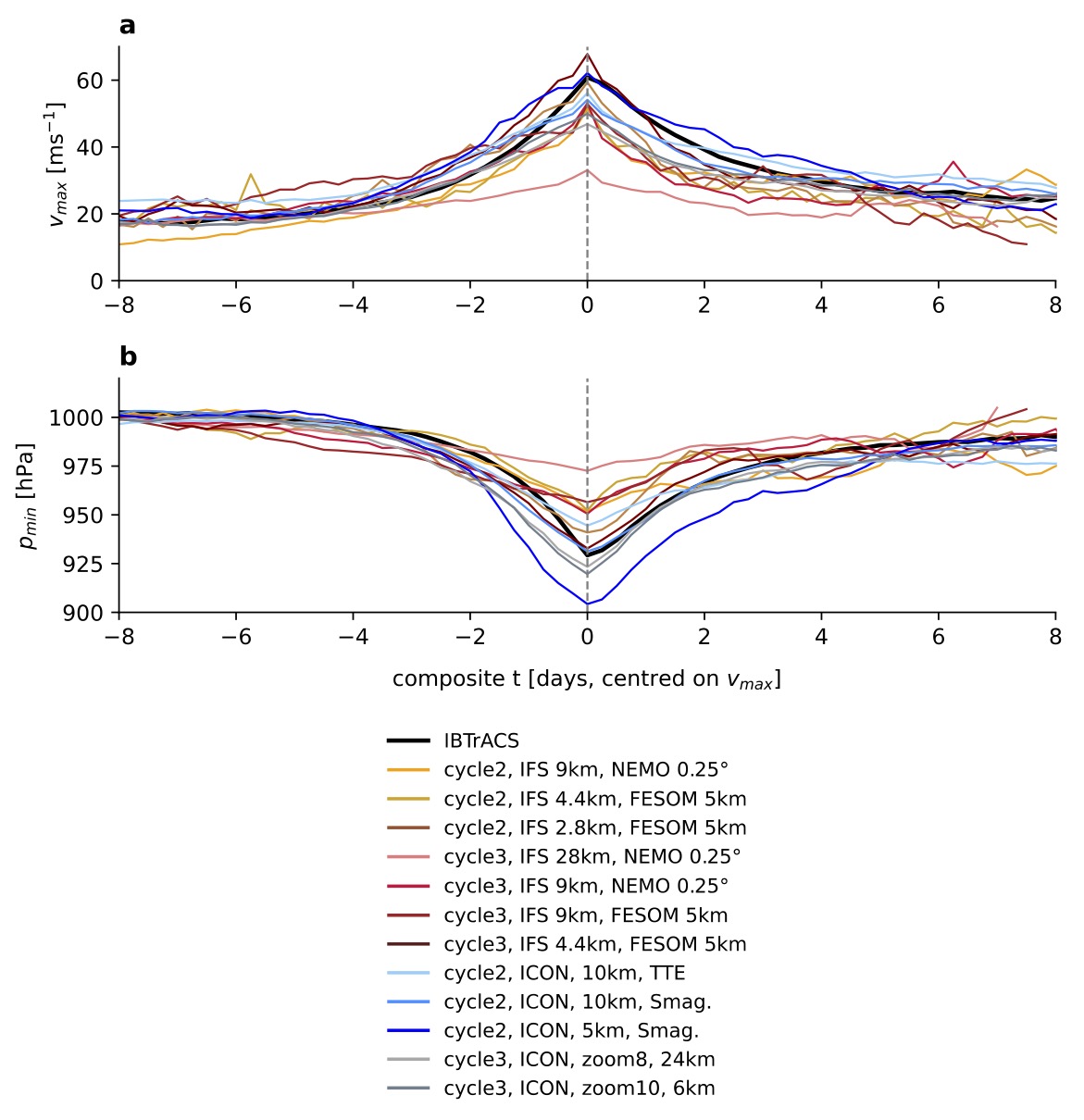
<p>The rate at which tropical cyclones intensify increases with finer atmospheric resolution (Figure 2). At low resolution (e.g., IFS at 28 km), even the most intense cyclones mature too slowly and reach a peak wind speed that is significantly lower than that observed in the real world. When resolution is increased, however, the intensification rate starts to resemble observations much more closely at resolutions of 4.4 km (IFS) and 5 km (ICON). These simulations also contain examples of tropical cyclone rapid intensification, which typical models do not represent. Rapid intensification cases <a href="https://alexbakey.wordpress.com/2022/11/13/upward-global-trends-in-tropical-cyclone-rapid-intensification/">have become more frequent over recent decades</a>, and forecasting these events is frequently error prone. Finer resolution is likely a key ingredient in understanding trends and improving forecasts.</p>

<p><img src="/images/blog/2024-08-28_fig2.jpg" alt="Figure 2" />
<strong><em>Figure 2</em></strong> | <em>Tropical cyclone intensity in the days before and after their peak intensity (indicated by the grey, dashed line) in IBTrACS observations over the period 1980–2022 (black) and nextGEMS simulations. Two measures of cyclone intensity are shown: (a) maximum wind speed (“v<sub>max</sub>”) and (b) minimum central pressure (“p<sub>min</sub>”). This analysis was performed for the strongest ten percent of both observed and simulated cyclones.</em></p>

<p>Our understanding of how climate change may impact tropical cyclones relies a lot on a generation of models whose resolutions are too coarse to capture critical hazards, such as rapid intensification. Therefore, Intergovernmental Panel on Climate Change assessments ascribe little to no confidence in the projected changes in such phenomena. State-of-the-art climate modelling may help reduce uncertainty. Our paper provides key evidence that tropical cyclone realism improves significantly with an atmospheric resolution of a few kilometres. In early 2024, the nextGEMS modelling teams completed simulations for longer periods: 1990–2010 and 2020–2050. These new data will help us better understand processes occurring in intense tropical cyclones and their behaviour in a warming climate. ♦</p>

<h3 id="authors-note">Author’s note</h3>

<p>‘Cycle 2’ and ‘cycle 3’ refer to phases of model development in nextGEMS during 2022–3. IFS is developed by the European Centre for Medium-Range Weather Forecasts. ICON is developed by the Max-Plank Institute for Meteorology. An edited version of this blog was originally published on <a href="https://nextgems-h2020.eu/advancing-tropical-cyclone-simulations-for-improved-climate-predictions-and-resilience/"><em>nextGEMS News</em></a>.</p>

<h3 id="references">References</h3>

<p>Baker, A. J., Vannière, B., and Vidale, P. L. <a href="https://agupubs.onlinelibrary.wiley.com/doi/10.1029/2024GL109841">On the realism of tropical cyclones simulated in global storm-resolving climate models</a>. <em>Geophysical Research Letters</em> <strong>51</strong>, e2024GL109841.</p>]]></content><author><name>Alexander J. Baker, Ph.D.</name><email>alexander.baker@reading.ac.uk</email></author><category term="tropical cyclones" /><summary type="html"><![CDATA[Tropical cyclones, including hurricanes and typhoons, rank among the most costly natural hazards. Recent research has revealed an increasing trend in the destructiveness of tropical cyclones over the last few decades, and highlighted the fact that socioeconomically underprivileged populations are disproportionately exposed to their impacts. Simulating realistic tropical cyclones is therefore a vital ambition in weather and climate modelling.]]></summary></entry></feed>